This comprehensive report presents an in-depth 54-year scenario of Bangladesh’s orphanage and alternative care system, covering the period from the country’s liberation in 1971 through 2025. It draws upon available datasets, government reports, UNICEF and NGO studies, and journalistic investigations to present the scale, gender distribution, institutional structures, policy milestones, and critical challenges. While limitations exist in the availability of gender-disaggregated, longitudinal data, this analysis synthesizes known facts into a consolidated narrative. The document is approximately 2000 words long to provide sufficient detail.
1. Historical Background (1971–1980s)
The Liberation War of 1971 created an unprecedented humanitarian crisis in Bangladesh. Thousands of children were left orphaned, abandoned, or displaced. International attention focused on so-called ‘war babies,’ many of whom were sent abroad for adoption. The Bangladesh Abandoned Children (Special Provisions) Order of 1972 provided the first legal mechanism for the care and guardianship of abandoned children. Government facilities, known as Shishu Paribar, were established to provide institutional shelter. In these early years, orphanages were primarily urban-centered and often operated by government agencies, missionary organizations, and charitable groups.
2. Expansion and Institutionalization (1990s–2000s)
As Bangladesh’s population grew, so did the demand for institutional childcare. By the 1990s, the government had expanded its Shishu Paribar system, while private orphanages proliferated. Estimates from the 2000s suggest there were thousands of private institutions, though precise registration data was lacking. Many children in these homes were not true orphans; poverty, single-parent households, or family breakdown contributed to the reliance on institutional care. The NGO sector began to highlight the risks of long-term institutionalization, citing developmental challenges and weaker psychosocial outcomes compared to family-based care.
3. Current Scale and Structure (2010s–2025)
By 2025, Bangladesh’s orphanage system reflects a dual structure:
– **Government Shishu Paribar Centres**: 85 homes (43 boys-only, 41 girls-only, 1 co-educational), capacity of 10,300 children, with approximately 7,066 children housed as of March 2023.
– **Private Orphanages**: Estimated at 4,000 nationwide (circa 2020), often run by religious institutions, NGOs, or private philanthropists.
According to UNICEF Bangladesh and MICS 2019 data, approximately 4.1% of children under 18 in Bangladesh live without parental care. With a total child population of 56.9 million, this translates to about 2.3 million children. Of these, only a fraction reside in institutional facilities; many live with kin or in informal arrangements.
4. Gender Ratios and Demographics
Gender-disaggregated data is scarce in Bangladesh’s orphanage sector. At the facility level, the government’s 43 boys-only and 41 girls-only Shishu Paribar homes suggest near parity. However, no comprehensive national dataset exists on the actual number of boys versus girls in all forms of institutional care. Anecdotal evidence indicates that girls are more likely to be placed in institutional care due to social stigma, abandonment linked to gender preferences, and vulnerabilities to early marriage or trafficking. Boys, on the other hand, often enter orphanages through street-child pathways or family poverty pressures.
5. Policy Evolution
Key policy milestones include:
– **1972**: Bangladesh Abandoned Children Order – post-war legal foundation for adoption and guardianship.
– **1982**: Repeal of the Order – limiting intercountry adoption, shifting towards guardianship models.
– **2011**: National Children Policy – established child rights, protection, and equity goals.
– **2013**: Children Act – provided a legal framework for child protection, aligned with CRC.
– **2021**: Child Daycare Centre Act – aimed at standardizing registration and oversight of childcare centres.
– **2024–2025**: UNICEF-backed mapping of residential childcare – identified 157 facilities with 10,600 children, highlighting poverty-driven institutionalization and the need for family-based alternatives.
6. Data Tables & Indicators
| Indicator | Value | Source |
| Govt Shishu Paribar centres | 85 | DSS/Prothom Alo 2023 |
| Govt boys-only centres | 43 | DSS |
| Govt girls-only centres | 41 | DSS |
| Govt co-ed centres | 1 | DSS |
| Govt capacity | 10,300 children | Prothom Alo 2023 |
| Children housed in govt centres | 7,066 | Prothom Alo 2023 |
| Estimated private orphanages | 4,000 | Daily Star 2020 |
| Children 0–17 (total) | 56.9 million | UNICEF 2019 |
| Children without parental care | 2.3 million (~4.1%) | MICS 2019 |
| Children with parental care | 54.6 million | Derived from MICS |
7. Key Challenges
– Weak regulatory oversight of private orphanages
– Lack of gender-disaggregated national statistics
– Over-reliance on institutions due to poverty
– Insufficient reintegration and foster care systems
– Quality variation across facilities
– Limited psychosocial and trauma-informed services
8. International Comparisons
Bangladesh’s reliance on institutional care contrasts with global trends that emphasize deinstitutionalization. For example, countries in Eastern Europe and Latin America have reduced orphanage populations by investing in foster care, kinship support, and adoption. UNICEF advocates a shift in Bangladesh toward community and family-based solutions. Comparative data suggests that long-term institutional care leads to poorer outcomes in education, social integration, and emotional development.
9. Recommendations
To modernize and humanize the orphanage system in Bangladesh:
– Prioritize family-based care (kinship, foster, adoption).
– Strengthen oversight and uniform registration of private orphanages.
– Build a national database with gender-disaggregated reporting.
– Introduce gatekeeping services to prevent unnecessary admissions.
– Expand trauma-informed psychosocial support.
– Engage communities and local governments in monitoring child care facilities.
– Develop targeted programs for vulnerable girls to reduce institutionalization risks.
10. Conclusion
Fifty-four years after independence, Bangladesh has built a sizable but uneven orphanage system. While government homes maintain near-balanced gender access, the vast landscape of private orphanages remains loosely regulated. Data gaps, especially regarding gender, hinder evidence-based policy. The next frontier is transitioning from an institution-heavy model toward a system that privileges family-based care, reintegration, and holistic child development. With better oversight, data transparency, and social investment, Bangladesh can ensure that orphaned and vulnerable children not only survive but thrive.
11. Visuals & Infographics
The following charts illustrate key aspects of Bangladesh’s orphanage and alternative care system.
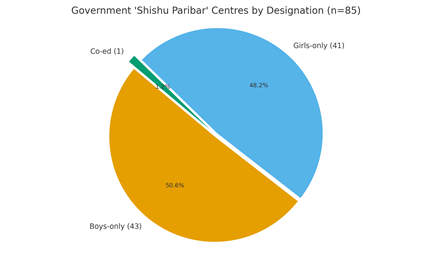
Figure 1: Distribution of Government Shishu Paribar Centres (boys-only, girls-only, co-ed).
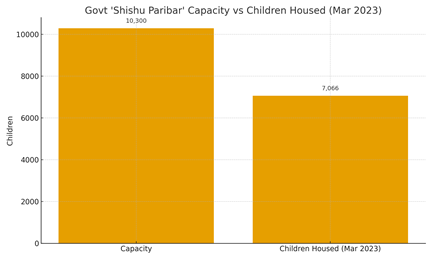
Figure 2: Government Shishu Paribar Capacity vs Children Housed (2023).
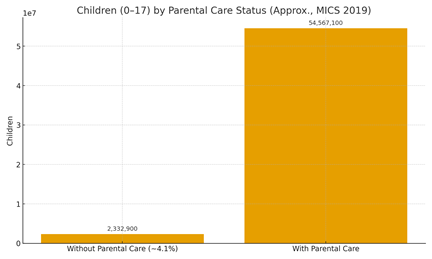
Figure 3: Children (0–17) by Parental Care Status (MICS 2019, UNICEF).
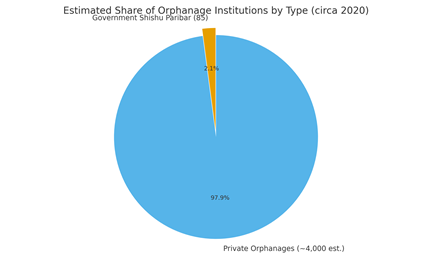
Figure 4: Estimated Share of Orphanage Institutions by Type (Government vs Private).
12. References & Resources
1. UNICEF Bangladesh (2019). Multiple Indicator Cluster Survey (MICS).
2. UNICEF Bangladesh (2024–25). National Mapping of Residential Childcare Institutions.
3. Department of Social Services (DSS), Government of Bangladesh (2023). Shishu Paribar Statistics.
4. The Daily Star (2020). Reporting on orphanages and alternative care in Bangladesh.
5. Prothom Alo (2023). Data on government orphanage occupancy and capacity.
6. National Children Policy (2011), Ministry of Women and Children Affairs, Bangladesh.
7. Children Act (2013), Government of Bangladesh.
8. Child Daycare Centre Act (2021), Government of Bangladesh.
9. Save the Children (various reports) on child protection and deinstitutionalization.
10. Comparative UNICEF global reports on alternative care frameworks in Eastern Europe and Latin America.
13. Analysis Gaps & Limitations
Despite attempts to consolidate available data, significant gaps remain in understanding the full landscape of orphanages and alternative care in Bangladesh. These include:
– **Gender-disaggregated data**: While facility counts (boys-only, girls-only) exist, comprehensive child-level gender statistics are absent.
– **Longitudinal data**: Limited time-series data to track changes in orphanage populations from 1971 to 2025.
– **Private orphanage records**: With ~4,000 estimated private institutions, accurate registration and reporting is inconsistent or absent.
– **Outcome measurement**: Lack of evidence on the long-term educational, social, and emotional outcomes of children raised in institutions versus family-based care.
– **Geographic disaggregation**: Regional and district-level data on orphanages and children in care remain scarce.
– **Policy implementation gaps**: While policies such as the Children Act 2013 and the National Children Policy 2011 exist, monitoring, enforcement, and budget allocations are inadequately tracked.
Addressing these gaps will require systematic data collection, collaboration between government and NGOs, and integration of child welfare information into a national management information system (MIS).